

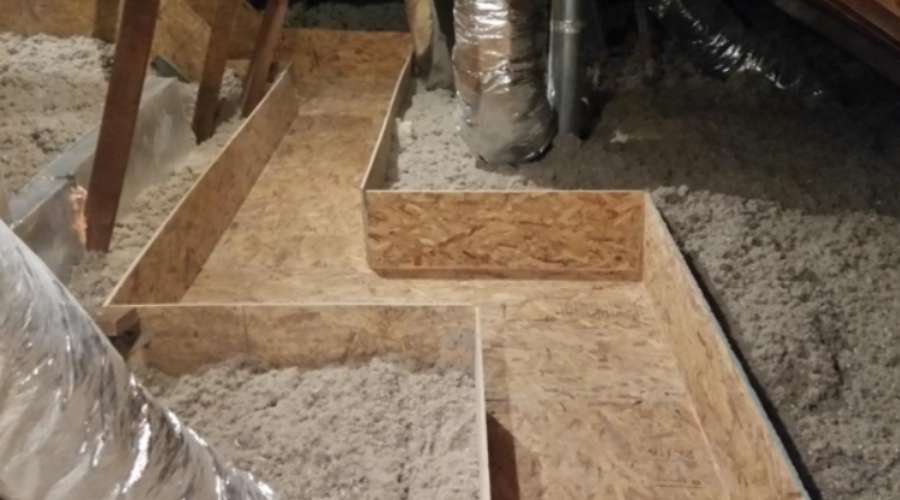
Should you insulate your attic floor or your roof? It sounds like a simple question, but the answer shapes everything: how your HVAC performs, what it costs to maintain your home’s temperature, whether you can use your attic for storage, and how much the project costs. Attic floor insulation in Virginia Beach is the right call for most homes, but understanding why, and understanding when the roof deck makes more sense, helps you make the right decision for your specific situation.
Two Ways to Insulate an Attic
There are two main approaches. Attic floor insulation means insulating the floor of the attic, which is also the ceiling of the rooms below. The attic itself stays unconditioned and open to outside air through the soffit and ridge vents. This is sometimes called a ventilated attic.
Roof deck insulation, also called a hot roof or unvented attic approach, means insulating at the underside of the roof itself. Usually with closed-cell spray foam. The attic becomes a conditioned space rather than an open, unconditioned one.
Both approaches work. Which one is right depends on how you use your attic and where your HVAC equipment lives.
The Case for Insulating the Attic Floor
For most Virginia Beach homes, attic floor insulation is the right recommendation. Here’s why.
It costs less. Insulating the attic floor is significantly cheaper than spraying the entire roof deck with closed-cell foam. The material cost and labor are both lower.
It allows the attic to breathe. A ventilated attic with good soffit and ridge ventilation can dry out when moisture enters. Virginia Beach’s humidity makes that drying capacity valuable. An attic that can breathe has a lower risk of moisture buildup under the roof deck.
It keeps HVAC out of the equation, when the equipment is in conditioned space. If your air handler and ductwork are inside your home, the attic temperature doesn’t matter to them. It can be 140 degrees up there all July and your HVAC is unaffected.
R-value targets are achievable quickly. The Department of Energy recommends R-49 to R-60 for attics in Climate Zone 3, which covers Virginia Beach. Blown-in insulation on an attic floor can reach those levels efficiently and at reasonable cost.
The Case for Insulating the Roof Deck
Roof deck insulation, making the attic a conditioned space, makes sense in specific situations. The most common one: your HVAC equipment is in the attic.
An air handler in an unconditioned attic that hits 140 degrees in July is working against itself. Ductwork in that heat loses efficiency even if the ducts themselves are insulated. Bringing the attic into conditioned space dramatically changes that calculation. Your HVAC runs more efficiently, ducts lose less energy, and the whole system works less hard.
It also makes sense if you want to use the attic as habitable space or finished storage. Finishing an attic requires conditioning it, and roof deck insulation is part of making that work. The tradeoff is cost. Closed-cell spray foam at the roof deck is significantly more expensive per square foot than blown-in on the attic floor.
What Virginia Beach’s Climate Requires
Virginia Beach summers are genuinely brutal for attics. Roof surface temperatures on a July afternoon can push 150 degrees. That energy radiates into the attic air, which heats dramatically. Without proper attic floor insulation, that heat moves through your ceiling into your living space and your AC fights it all afternoon.
Proper attic floor insulation at R-49 to R-60 creates a meaningful thermal break. Your ceiling stops feeling like a radiator. Your AC runs shorter cycles. Your home stays more comfortable between 2 and 6 in the afternoon when attic heat is at its peak.
But insulation alone doesn’t tell the whole story. Air sealing matters just as much. Every penetration in your attic floor, recessed lights, plumbing stacks, HVAC boots, the tops of interior walls, needs to be sealed before insulation goes on top. Air leaks move heat faster than conduction through an insulated surface. Seal first, then insulate.
What Type of Insulation Works on an Attic Floor?
For attic floors, blown-in insulation is the most common and practical choice. Blown-in cellulose fills irregular joist bays completely, works around obstructions, and achieves high R-values per inch. Blown-in fiberglass settles less over time and has an edge in humid environments because it doesn’t absorb moisture.
Batt insulation works on attic floors too, particularly in open, accessible attics with standard framing. For existing Virginia Beach homes where the attic has old insulation, lots of penetrations, and tight access points, blown-in is usually the more practical choice.
How Level Home Pros Gets It Right
We use thermal imaging to map your attic before recommending anything. That shows us where the floor insulation is thin, where air is moving, and whether the attic ventilation is functioning. Then we air seal, then we insulate. In that order. No exceptions.
Our attic insulation work is backed by a Lifetime Labor Warranty and we offer next-day quotes throughout the Virginia Beach and Hampton Roads area. Call 757-834-2059 or book online at levelhomepros.com.
Frequently Asked Questions
Q: What R-value do I need for attic floor insulation in Virginia Beach?
A: The DOE recommends R-49 to R-60 for Climate Zone 3, which includes Virginia Beach. Blown-in insulation on an attic floor can reach these targets efficiently.
Q: Can I walk on my attic floor after adding blown-in insulation?
A: The insulation can be disturbed by walking through it. Properly installed attic walkboards or catwalks preserve insulation while giving you access to mechanical equipment.
Q: Should I remove old attic insulation before adding new?
A: Not always. If the existing insulation is dry and in good condition, adding on top is fine. If it’s contaminated, wet, or pest-damaged, removal comes first.
Q: How long does attic floor insulation take to install?
A: A typical single-family attic in Virginia Beach takes one day or less, depending on attic size and access. Air sealing adds time on the front end but is well worth it.
Q: Does adding attic floor insulation actually reduce energy bills?
A: Yes, consistently. Properly installed attic insulation is one of the highest-return home improvements available. Exact savings depend on your current insulation level, home size, and utility rates.